Facebook
 X
X
 Pinterest
 Copy Link
A Central Florida Plumbing Expert Weighs In!
If you’re a homeowner wondering “how do I know how old my water heater is” or “when should I replace my water heater,” you’re not alone. It’s one of the most common questions homeowners ask, and it’s also one of the easiest things to check once you know where to look.
To get real answers (not generic internet advice), I sat down with Justin Smith, CEO and Owner of Hurricane Plumbing and Repair, to talk through everything homeowners should know about water heater age, lifespan, maintenance, and when it’s time to start planning for a replacement.
How Can a Homeowner Determine the Age of Their Water Heater?
According to Justin, the answer is hiding in plain sight on the unit itself.
“Water heater age is going to be within the first four letters or numbers in the serial number,” Justin explains. On an AO Smith water heater specifically, the first two digits of the serial number represent the year it was manufactured, and the last two digits represent the week.
Every manufacturer codes their serial numbers a little differently, but Justin says most systems use a similarly simple format once you know what to look for. If you’re not sure how to read yours, a quick search for your brand name plus “serial number date” or a call to a local plumber can clear it up in minutes.
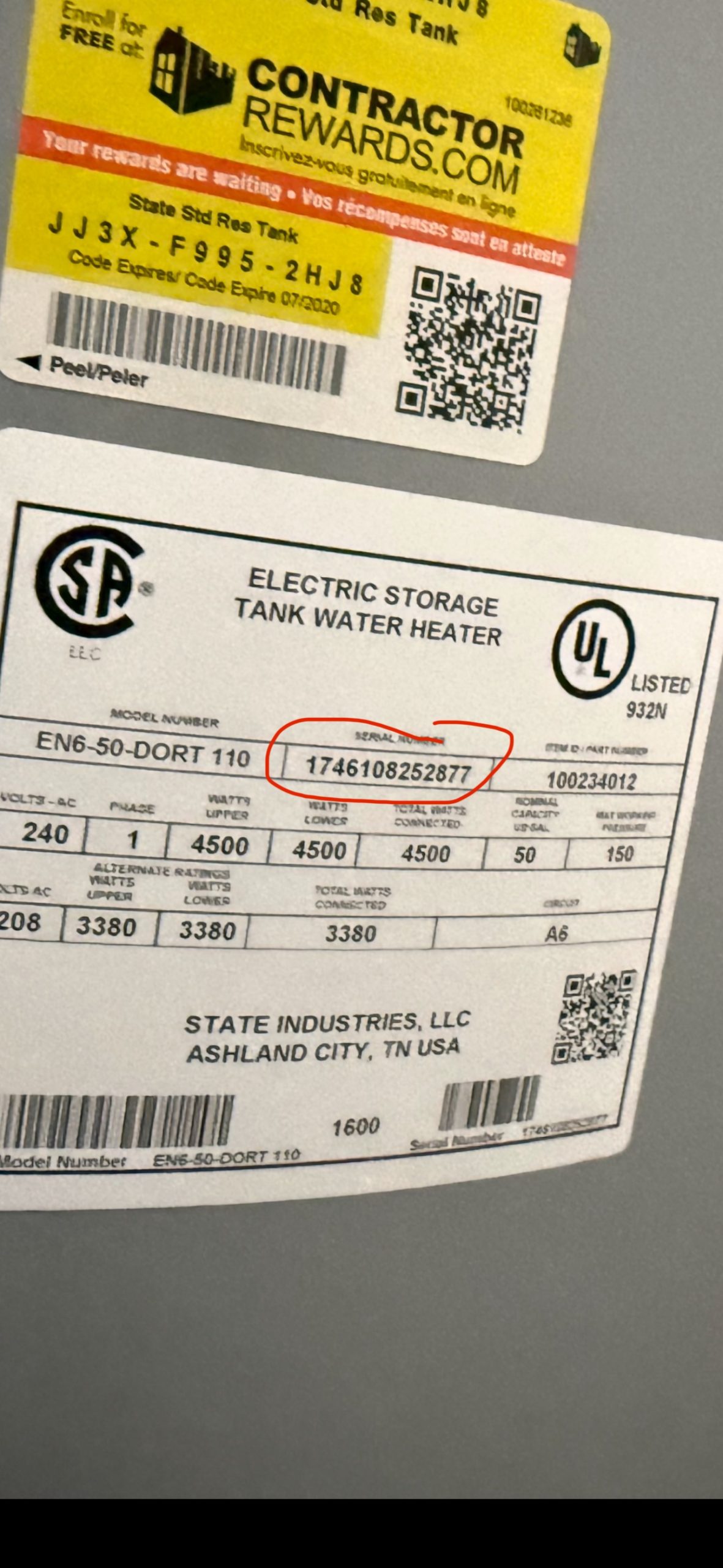
Wondering how old a water heater is? The serial number often contains the answer. In this example, the first two numbers, 17, represent the year the water heater was manufactured, or 2017. The second pair of numbers, 46, represents the 46th week of the year. Together, the code 1746 indicates that this water heater was manufactured during week 46 of 2017.
Common Signs Your Water Heater Is Nearing the End of Its Life
Justin says there are a few clear warning signs homeowners should watch for:
- Running out of hot water faster than normal. If showers that used to last through a full cycle now run cold halfway through, that’s often an early sign of a tank losing efficiency.
- Rust or water pooling around the unit. Any visible rust on the tank or water anywhere near the base of the water heater is a signal that shouldn’t be ignored.
When Should You Start Planning for a Replacement?
This is where Justin’s advice gets especially practical. Standard tank water heaters typically last 8 to 12 years, but the manufacturer warranty is usually only 6 years.
“Once the manufacturer warranty is up, I would start planning to replace it sooner rather than later,” Justin says. To put that in perspective, he points out that a water heater three years past its warranty isn’t necessarily an emergency, but it’s a strong signal to start budgeting and planning rather than waiting for a failure.
The takeaway: you don’t need to panic the day your warranty expires, but that date is a good trigger to start researching options so you’re not scrambling during a cold-water emergency.
Tankless vs. Traditional Tank Water Heaters: What’s the Real Difference?
Homeowners considering an upgrade often ask about tankless systems, and Justin has strong, specific opinions based on years in the field.
He’s not a fan of electric tankless units. “It requires so much electricity just to get 5 gallons a minute,” he explains, noting that the power demand can make electric tankless systems less practical for many households.
Instead, Justin recommends natural gas or propane tankless water heaters as the most efficient option on the market. The core benefit comes down to how each system handles standby heat loss. A traditional tank keeps a large reservoir of water sitting at 120 degrees around the clock, whether you’re using hot water or not, which wastes energy. A tankless system has zero reservoir and only heats water on demand, so there’s no energy spent maintaining a tank of hot water you’re not using.
Routine Maintenance That Extends the Life of a Water Heater
The good news is that extending the life of a standard tank water heater doesn’t require a professional visit every time. Justin shared a simple DIY maintenance step homeowners can do at home:
- Hook up a garden hose to the bottom boiler drain of the tank.
- Let the water run for 5 to 10 minutes to flush out sediment buildup.
- Repeat this process twice a year.
“Super easy,” Justin says, and it’s one of the most overlooked ways homeowners can add years to their water heater’s life without spending a dime on a service call.
The Bottom Line for Homeowners
Whether you’re buying a home, settling into a new one, or just trying to plan ahead for a big-ticket replacement, knowing your water heater’s age and condition is one of those small checks that can save you from a stressful, cold-shower surprise. Check the serial number, watch for the warning signs Justin outlined, a nd consider flushing your tank twice a year to keep it running as long as possible.
A huge thank you to Justin Smith and the team at Hurricane Plumbing and Repair for sharing his expertise for this post. You can schedule your service call by calling (321) 291-7857 or on their website: hurricaneplumbingrepair.com
Angela “Angie” Green REALTOR®| (812) 319-3814 | The Green Team| Contact me | Check out my Buying/Selling Tips